AI Isn’t Replacing Product Managers. It’s Repricing Their Time.

Introduction
For years, product management had one constant problem: there was never enough time. Feedback had to be read. Research had to be synthesized. Competitive updates had to be tracked down. PRDs had to be written. Stakeholders needed updates. A lot of a PM’s week wasn’t spent deciding anything — it was spent preparing to decide.
AI is quietly collapsing that preparation time. A PM can take a stack of customer conversations, ask for the themes, draft a first-pass PRD, or compare a handful of competitors in a fraction of the time it used to take.
That’s a real gain. It also creates a less comfortable question: what happens when producing product work gets cheap faster than making a good product decision does?
The Bottleneck Didn’t Disappear. It Relocated.
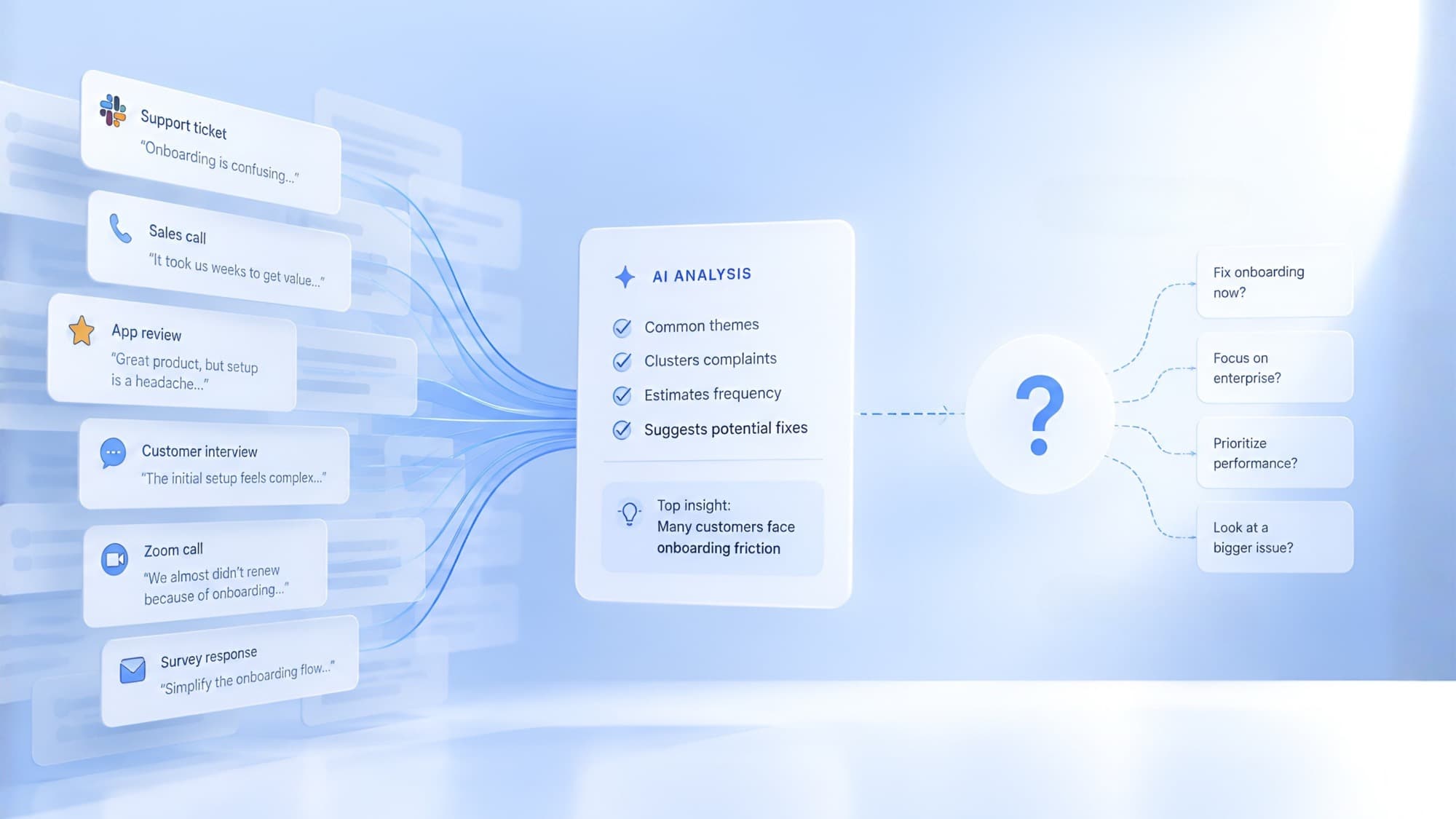
AI can tell you that four hundred customers mentioned the same onboarding friction. It can cluster the complaints, estimate frequency, even suggest a fix. What it can’t tell you is whether onboarding is actually the most important problem to solve this quarter.
That depends on context an AI tool usually doesn’t have:
- Who’s actually affected — are the accounts reporting this your highest-value customers, or a segment you’re not optimizing for?
- How painful the workaround really is — annoying and unworkable are different problems with different urgency.
- What else is already committed — a fix that’s right in isolation can still be wrong this quarter, if it collides with a deadline nobody told the AI about.
- Whether the labeled problem is even the real one — “onboarding” might be a symptom of a segmentation issue no one’s named yet.

The PM’s value was never in producing the analysis. It was always in making the call the analysis can’t make by itself.
Why “AI Will Replace PMs” Gets the Direction Wrong
The role isn’t disappearing. Its shape is changing. The production layer — drafting, synthesizing, summarizing — is getting cheaper by the month. The judgment layer — deciding what actually matters, and why, given everything AI doesn’t know — is becoming the entire differentiator.
That means the PM question worth asking is shifting:
- Less: “How do I produce this faster?”
- More: “Is this even the right thing to produce?”
That sounds like a small shift. It isn’t. It changes what “a good PM” looks like. The old measure was partly about how much work someone could personally push through. The new measure is the quality of the decisions they create around the team — can they frame the problem correctly, and can they say no to the wrong thing convincingly, even when AI made the wrong thing look easy to build?
Final Thought
AI didn’t shrink the PM job. It stripped away the parts of it that were never really the job to begin with. What’s left — deciding what matters, and standing behind that call — was always the hard part. It’s just no longer possible to hide it behind how busy the preparation used to look.
Learn how leading teams turn feedback into actionLearn How Leading Teams Turn Feedback Into Action

AI Turns Customer Research From an Event Into a SystemAI Turns Customer Research From an Event Into a System
Customer research used to be something a team scheduled — a round of interviews, a quarterly survey, a sprint before a launch. Structurally, that was always a snapshot. AI changes the cadence, not just the speed: research becomes a standing picture rather than a periodic report. But a continuously updated picture can look comprehensive without being representative.Customer research used to be something a team scheduled — a round of interviews, a quarterly survey, a sprint before a launch. Structurally, that was always a snapshot. AI changes the cadence, not just the speed: research becomes a standing picture rather than a periodic report. But a continuously updated picture can look comprehensive without being representative.
16 Sep 202616 Sep 2026

AI Isn’t Replacing Product Managers. It’s Repricing Their Time.AI Isn’t Replacing Product Managers. It’s Repricing Their Time.
A lot of a PM’s week was never spent deciding anything — it was spent preparing to decide. AI collapses that preparation time, but the bottleneck didn’t disappear; it relocated. Producing product work is getting cheap faster than making a good product decision is, and judgement is becoming the entire differentiator.A lot of a PM’s week was never spent deciding anything — it was spent preparing to decide. AI collapses that preparation time, but the bottleneck didn’t disappear; it relocated. Producing product work is getting cheap faster than making a good product decision is, and judgement is becoming the entire differentiator.
1 Sep 20261 Sep 2026
Security & Compliance You Can Trust



Security & Compliance You Can Trust
See how Pulse works with your data
Book a Demo