Product Intelligence for B2B Technology Enterprises
Pulse connects product requests, support tickets, sales feedback, and customer signals, helping Product and CS teams build what matters, prioritise with confidence, and close the loop







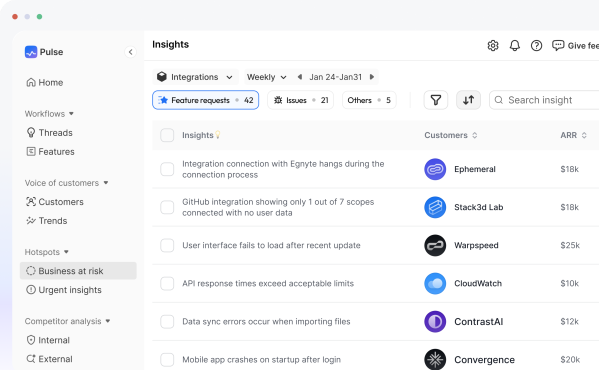
Integration connection with Egnyte hangs during the connection process

GitHub integration showing only 1 out of 7 scopes connected with no user data

User interface fails to load after recent update

API response times exceed acceptable limits

Data sync errors occur when importing files

Mobile app crashes on startup after login

Integration connection with Egnyte hangs during the connection process
GitHub integration showing only 1 out of 7 scopes connected with no user data
User interface fails to load after recent update
API response times exceed acceptable limits
Data sync errors occur when importing files
Mobile app crashes on startup after login
Who's it for? Product Managers &
CS Teams in B2B Orgs
Turn fragmented product and customer feedback into a clear, prioritised roadmap for action.
Unify
Unify product requests, support issues, sales signals, and customer feedback
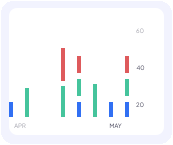





Unify
Unify product requests, support issues, sales signals, and customer feedback
Deduplicate
Identify themes, deduplicate noise, and surface root causes





Prioritise what actually matters
Prioritise work by ARR at risk, churn probability, renewals, and NRR impact
Validate with customers
Validate priorities with customers via surveys and shared roadmaps

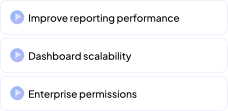
Turn Insights into Action
Push structured outputs into Jira, Linear, Notion, and downstream tools
How Pulse's Product
Intelligence Engine Works
Built for scale, speed, and cross-functional execution
Core Capabilities
Pulse brings structure, intelligence, and business context to every step of the product decision lifecycle.




AI in Action
Intelligent agents that learn your product taxonomy, detect patterns across feedback, and surface actionable insights
Deduplication Agent
Groups similar feedback from tickets, calls, surveys, and requests — eliminating noise and revealing the real size and impact of each problem




Deduplication Agent
Groups similar feedback from tickets, calls, surveys, and requests — eliminating noise and revealing the real size and impact of each problem
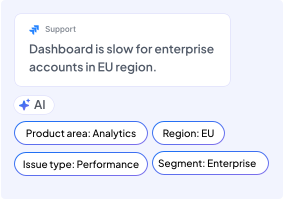
Classification Copilot
Learns how your teams think and auto-labels feedback by product area, issue type, customer segment, and region. Humans stay in control — accept, edit, or override in one click.


Comprehension Copilot
Ask questions like "What's driving churn in mid-market accounts?" and get structured answers with linked sources and context.




Hotspot Builder
Layers themes, volumes, revenue signals, competitor mentions, and urgency to surface the riskiest gaps and biggest opportunities across products and segments.

Roadmap Intelligence
Turns insights into a clear, shareable roadmap mapped to quarters, initiatives, and impact metrics — with every item traceable back to real customer feedback.



Business Outcomes


Learn how leading teams turn feedback into actionLearn How Leading Teams Turn Feedback Into Action

AI Turns Customer Research From an Event Into a SystemAI Turns Customer Research From an Event Into a System
Customer research used to be something a team scheduled — a round of interviews, a quarterly survey, a sprint before a launch. Structurally, that was always a snapshot. AI changes the cadence, not just the speed: research becomes a standing picture rather than a periodic report. But a continuously updated picture can look comprehensive without being representative.Customer research used to be something a team scheduled — a round of interviews, a quarterly survey, a sprint before a launch. Structurally, that was always a snapshot. AI changes the cadence, not just the speed: research becomes a standing picture rather than a periodic report. But a continuously updated picture can look comprehensive without being representative.
16 Sep 202616 Sep 2026

AI Isn’t Replacing Product Managers. It’s Repricing Their Time.AI Isn’t Replacing Product Managers. It’s Repricing Their Time.
A lot of a PM’s week was never spent deciding anything — it was spent preparing to decide. AI collapses that preparation time, but the bottleneck didn’t disappear; it relocated. Producing product work is getting cheap faster than making a good product decision is, and judgement is becoming the entire differentiator.A lot of a PM’s week was never spent deciding anything — it was spent preparing to decide. AI collapses that preparation time, but the bottleneck didn’t disappear; it relocated. Producing product work is getting cheap faster than making a good product decision is, and judgement is becoming the entire differentiator.
1 Sep 20261 Sep 2026
Security & Compliance You Can Trust




Security & Compliance You Can Trust
See how Pulse works with your data
Book a Demo