Align: The Hidden System Every Scaling Company Needs
Introduction
Misalignment rarely announces itself. It shows up quietly. Sales says deals are stalling. Support says tickets are rising. CS says churn risk is growing. Product says roadmap is on track. Everyone is right. And that's the problem.
Each function sees reality through its own lens. Without a shared intelligence layer, alignment depends on meetings, not systems.
Why Alignment Breaks as Companies Scale
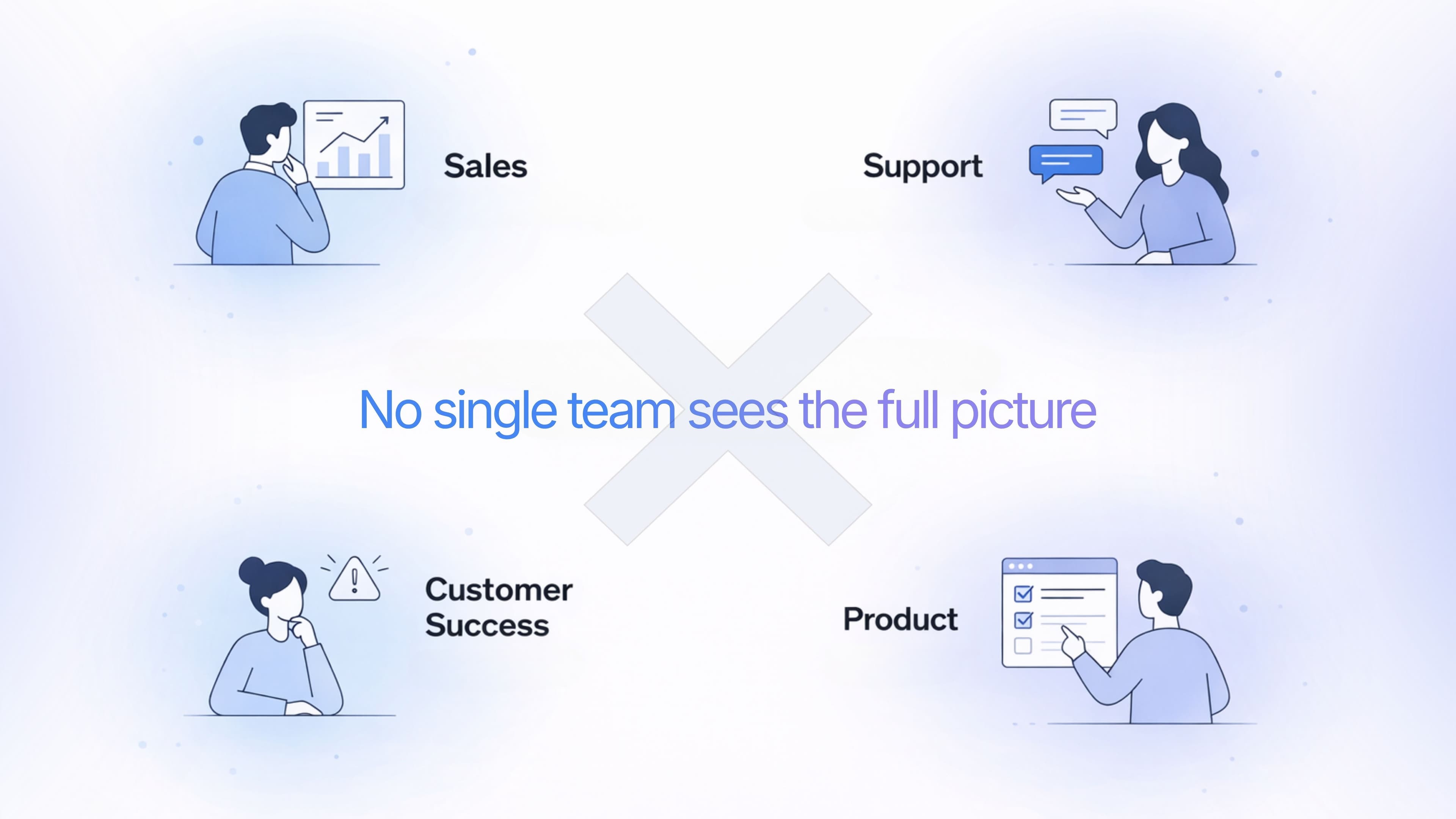
In early-stage teams, alignment happens naturally. Everyone sits in the same room. Everyone hears the same feedback. Everyone understands context. As companies grow, signals fragment. Sales sees CRM notes. Support sees tickets. CS sees renewal risk. Product sees feature requests. No single team sees the full picture.
This fragmentation creates:
- conflicting priorities
- duplicate work
- delayed decisions
- internal friction
Meetings Don’t Solve Alignment
Most organisations try to fix misalignment with more communication:
- weekly syncs
- cross-functional reviews
- escalation threads
- dashboards
These help temporarily. But they don’t solve the underlying problem: teams are still looking at different data. Alignment isn’t a communication problem. It’s an intelligence problem.
The Role of Shared Intelligence Systems
Modern organisations need a layer that merges signals across functions and translates them into one coherent narrative. This system must:
- unify feedback sources
- weigh business impact
- detect emerging risks
- trigger cross-functional actions
- surface one version of truth
Without this layer, teams interpret reality differently. With it, they move together.
How Pulse Enables Structural Alignment
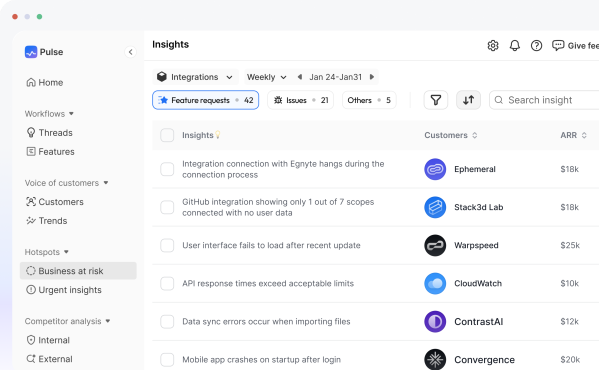
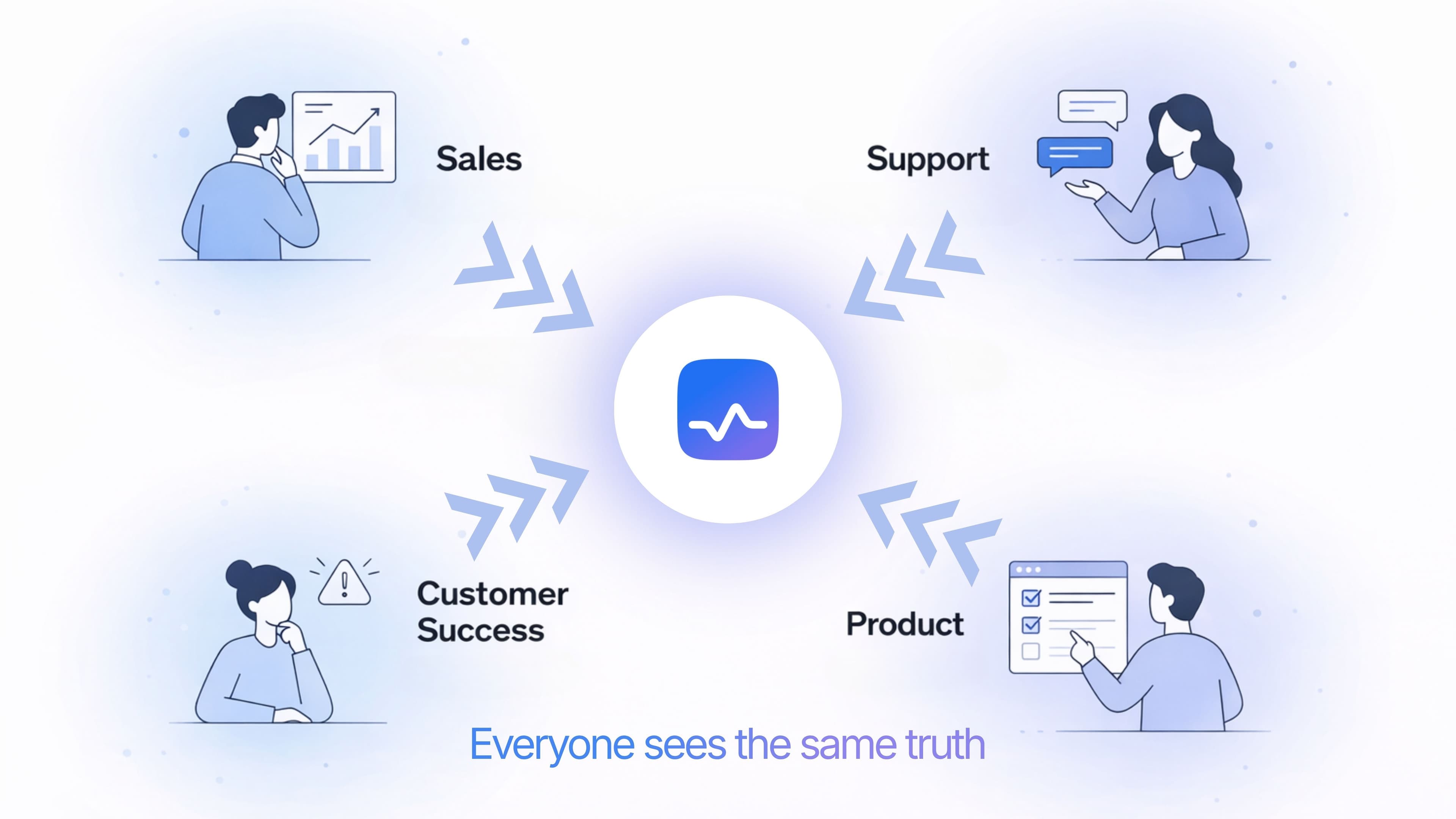
Pulse operates as a cross-functional intelligence engine. It merges signals from:
- customer conversations
- product feedback
- sales notes
- support tickets
- operational logs
Then it connects them to:
- revenue exposure
- customer tier
- lifecycle stage
- strategic accounts
When thresholds are crossed, Pulse triggers actions automatically:
- alerts CS about at-risk accounts
- briefs Sales on blockers
- surfaces priorities to Product
- provides leadership summaries
Everyone sees the same story.
What Real Alignment Looks Like
True alignment isn’t consensus. It’s shared clarity. When intelligence is unified:
- Product doesn’t guess priorities
- Sales doesn’t chase anecdotal requests
- CS doesn’t escalate blindly
- Leadership doesn’t rely on intuition
The organisation moves as one system.
Key Takeaways
- Misalignment comes from fragmented signals.
- Meetings don’t fix fragmented data.
- Alignment requires shared intelligence.
- Cross-functional visibility accelerates execution.
- Structural alignment scales better than conversational alignment.
Closing Thought
Companies don’t slow down because teams disagree. They slow down because teams see different realities. Alignment begins when everyone sees the same truth.

Learn how leading teams turn feedback into actionLearn How Leading Teams Turn Feedback Into Action

AI Turns Customer Research From an Event Into a SystemAI Turns Customer Research From an Event Into a System
Customer research used to be something a team scheduled — a round of interviews, a quarterly survey, a sprint before a launch. Structurally, that was always a snapshot. AI changes the cadence, not just the speed: research becomes a standing picture rather than a periodic report. But a continuously updated picture can look comprehensive without being representative.Customer research used to be something a team scheduled — a round of interviews, a quarterly survey, a sprint before a launch. Structurally, that was always a snapshot. AI changes the cadence, not just the speed: research becomes a standing picture rather than a periodic report. But a continuously updated picture can look comprehensive without being representative.
16 Sep 202616 Sep 2026

AI Isn’t Replacing Product Managers. It’s Repricing Their Time.AI Isn’t Replacing Product Managers. It’s Repricing Their Time.
A lot of a PM’s week was never spent deciding anything — it was spent preparing to decide. AI collapses that preparation time, but the bottleneck didn’t disappear; it relocated. Producing product work is getting cheap faster than making a good product decision is, and judgement is becoming the entire differentiator.A lot of a PM’s week was never spent deciding anything — it was spent preparing to decide. AI collapses that preparation time, but the bottleneck didn’t disappear; it relocated. Producing product work is getting cheap faster than making a good product decision is, and judgement is becoming the entire differentiator.
1 Sep 20261 Sep 2026
Security & Compliance You Can Trust




Security & Compliance You Can Trust
See how Pulse works with your data
Book a Demo