Analyse: Turning Customer Signals into Root Causes (Not Just Themes)
Introduction
Most companies don’t lack customer data. They lack understanding.
Every day, signals pour in from support tickets, sales calls, app reviews, NPS responses, and internal escalations. Teams know issues exist. They can even list them.
But knowing what customers said is not the same as knowing what’s actually happening.
That gap — between observation and understanding — is where most product decisions go wrong.
Analysis is supposed to close that gap. Yet in many organisations, it doesn’t.
Why?
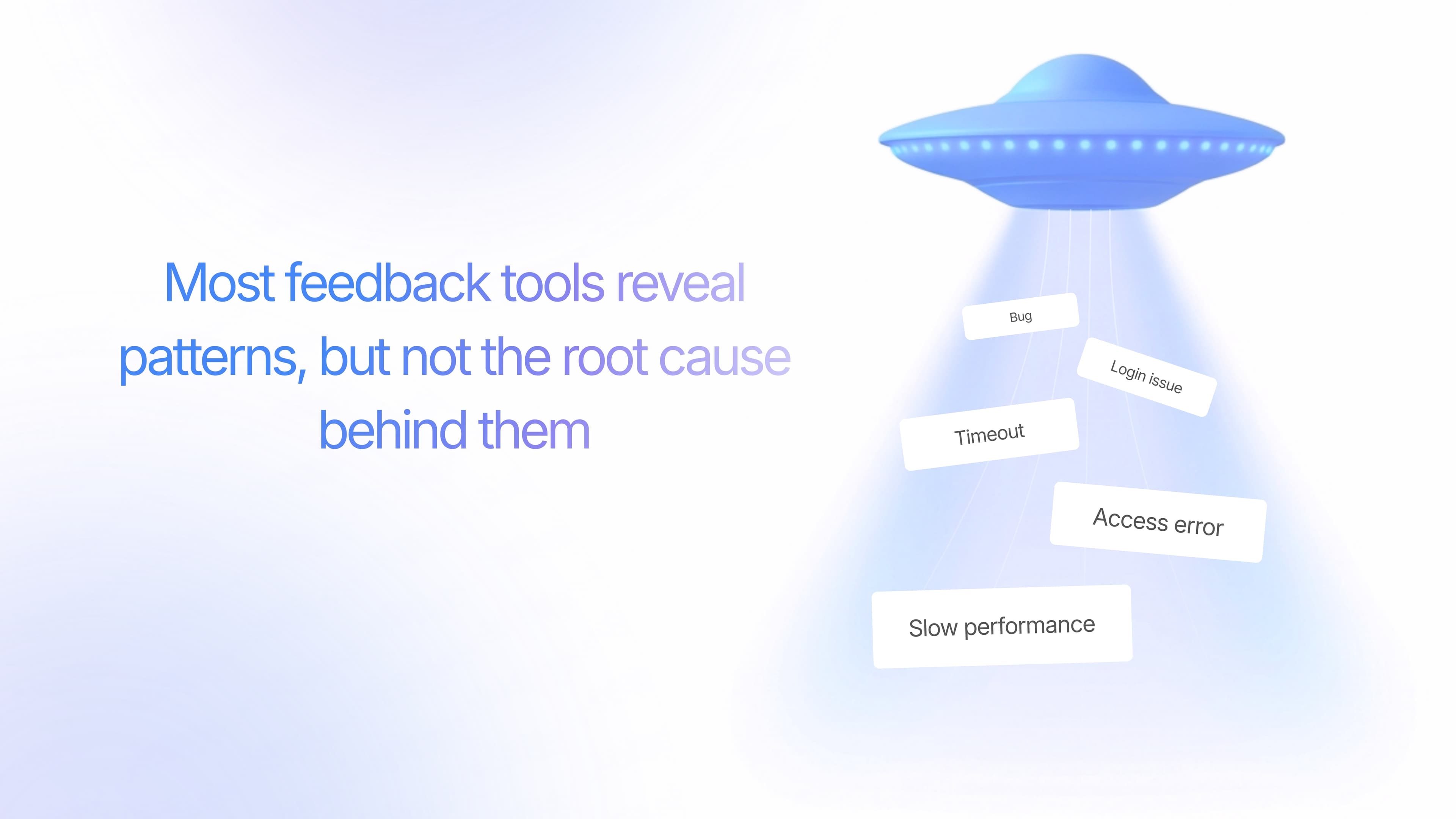
Because most feedback systems show themes. Very few reveal causes.
Why Traditional Feedback Analysis Falls Short
Most existing platforms rely on dashboards and tagging systems.
They can tell you:
- how many complaints mention “performance”
- which feature is requested most
- how sentiment trends changed this month
Those are useful metrics.
But they don’t answer the questions leadership actually cares about:
- Why is this happening?
- Who is affected?
- How urgent is it?
- What revenue is at risk?
This is the core limitation of analytics-first systems: they describe symptoms but don’t diagnose problems.
The Difference Between Themes and Intelligence
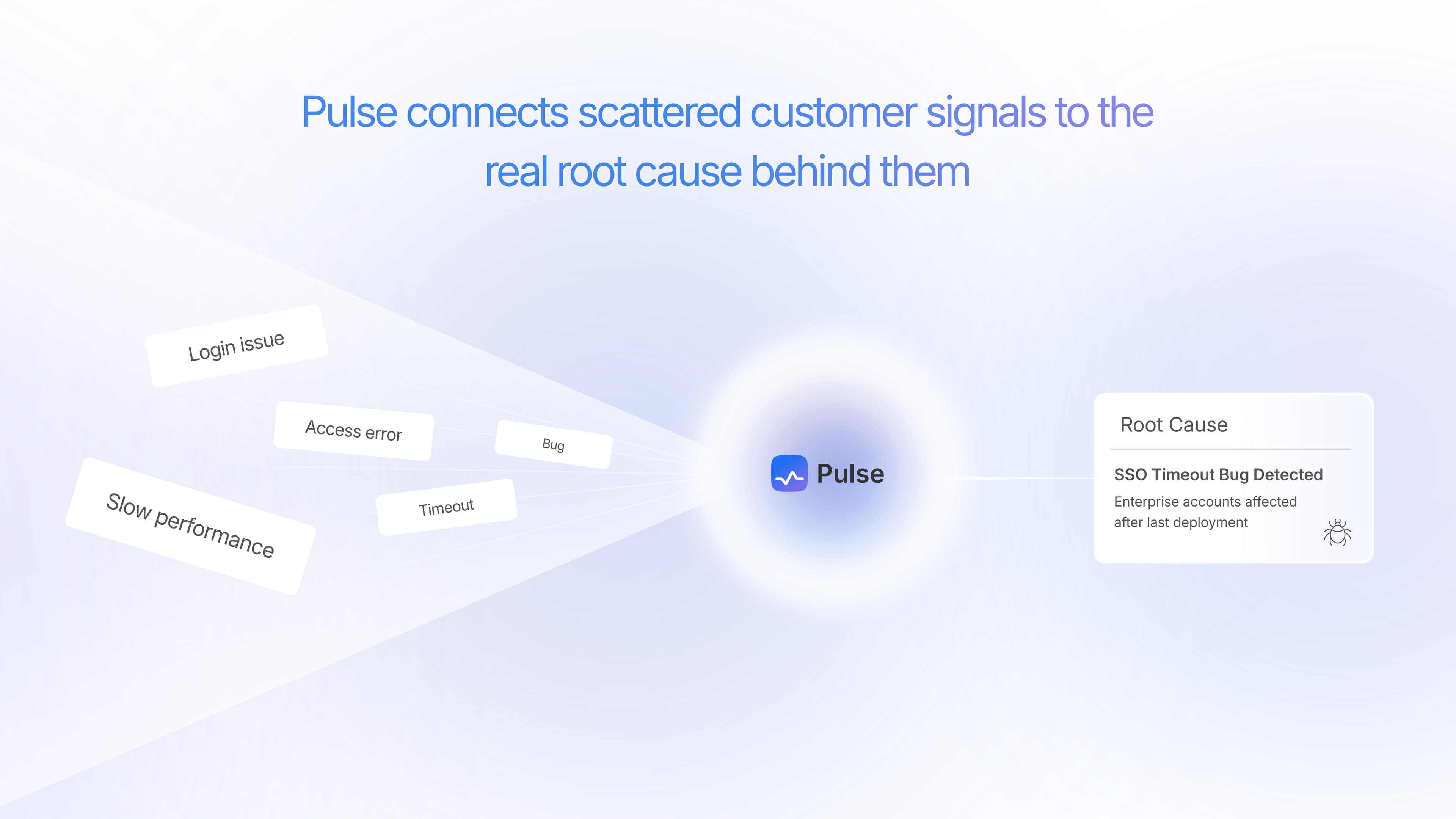
A theme is a pattern. A root cause is an explanation.
Example: Theme → “Customers reporting login issues.” Root cause → “SSO timeout bug affecting enterprise accounts using Okta after last deployment.”
Themes inform awareness. Root causes enable decisions.
Finding root causes manually requires analysts to:
- read transcripts
- compare tickets
- track release timelines
- correlate customer segments
- validate patterns
That’s hours of work for a single issue. At enterprise scale, it becomes impossible.
How Agentic Analysis Changes the Equation
Modern AI systems — especially agentic ones — don’t just summarise data. They reason across it.
Instead of analysing one record at a time, they analyse relationships between signals.
Effective analysis agents must:
- cluster similar signals across channels
- connect symptoms to drivers
- detect anomalies over time
- track post-release regressions
- identify segment-specific issues
- calculate business impact
This transforms analysis from static reporting into dynamic intelligence.
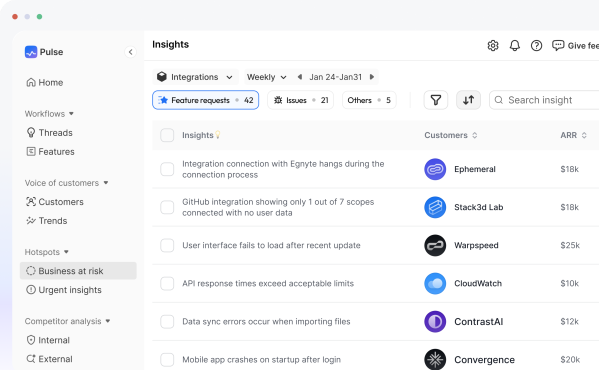
How Pulse Performs Intelligence-Grade Analysis
Pulse’s analysis layer operates continuously across all ingested feedback. It doesn’t just aggregate comments. It interprets them.
Here’s how:
Signal Clustering
Feedback from support, CRM, calls, and surveys is grouped into unified themes — regardless of wording.
Root Cause Detection
Pulse connects symptoms to underlying drivers, such as:
- infrastructure latency
- permission errors
- workflow breaks
- release regressions
Impact Mapping
Each issue is automatically linked to:
- affected accounts
- ARR exposure
- segment distribution
- growth rate
Trend Monitoring
Pulse tracks which issues are:
- growing fastest
- newly emerging
- stabilising
- declining
What Leadership Actually Gets
Instead of dashboards full of charts, teams receive clear answers:
- Top issues by revenue exposure
- Fastest-growing customer blockers
- New risks affecting enterprise accounts
- Trends tied directly to releases
That changes decision-making speed dramatically.
Customers using Pulse have reported 30–40% faster decision cycles because teams stop investigating and start acting.
Why Analysis Determines Prioritisation Quality
Weak analysis produces noisy priorities.
If root causes aren’t clear, teams end up:
- fixing symptoms
- shipping low-impact features
- overreacting to loud customers
- ignoring silent churn risks
Strong analysis creates decision clarity.
When the system identifies what’s happening and why, prioritisation becomes mathematical rather than political.
Key Takeaways
- Themes are not intelligence.
- Analysis must connect signals to causes.
- Dashboards describe problems. Intelligence systems diagnose them.
- Agentic systems enable cross-source reasoning.
- The quality of analysis determines the quality of decisions.
Closing Thought
When teams ask: “What’s going on?”
They’re not looking for charts. They’re looking for answers.
Analysis is where those answers are born.
Learn how leading teams turn feedback into actionLearn How Leading Teams Turn Feedback Into Action
AI Turns Customer Research From an Event Into a SystemAI Turns Customer Research From an Event Into a System
Customer research used to be something a team scheduled — a round of interviews, a quarterly survey, a sprint before a launch. Structurally, that was always a snapshot. AI changes the cadence, not just the speed: research becomes a standing picture rather than a periodic report. But a continuously updated picture can look comprehensive without being representative.Customer research used to be something a team scheduled — a round of interviews, a quarterly survey, a sprint before a launch. Structurally, that was always a snapshot. AI changes the cadence, not just the speed: research becomes a standing picture rather than a periodic report. But a continuously updated picture can look comprehensive without being representative.
16 Sep 202616 Sep 2026
AI Isn’t Replacing Product Managers. It’s Repricing Their Time.AI Isn’t Replacing Product Managers. It’s Repricing Their Time.
A lot of a PM’s week was never spent deciding anything — it was spent preparing to decide. AI collapses that preparation time, but the bottleneck didn’t disappear; it relocated. Producing product work is getting cheap faster than making a good product decision is, and judgement is becoming the entire differentiator.A lot of a PM’s week was never spent deciding anything — it was spent preparing to decide. AI collapses that preparation time, but the bottleneck didn’t disappear; it relocated. Producing product work is getting cheap faster than making a good product decision is, and judgement is becoming the entire differentiator.
1 Sep 20261 Sep 2026
Security & Compliance You Can Trust




Security & Compliance You Can Trust
See how Pulse works with your data
Book a Demo