How Data Duplication Undermines Product Teams - And How Pulse Makes Feedback Effortlessly Clean
Introduction
Every product team today has the same problem: too much feedback, coming from too many places, at a pace no human can realistically keep up with. Tickets from Zendesk, customer notes in Salesforce, Slack threads, emails, call transcripts, NPS comments—all of it shows up looking urgent, important, and usually… duplicated.
Data duplication has become one of the most underestimated productivity killers inside SaaS and digital enterprises. When the same request appears four different ways across four different tools, it skews demand signals, drains team bandwidth, and derails prioritisation.

What is Data Duplication in Product Feedback?
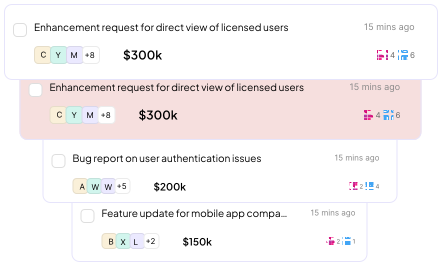
Data duplication in product feedback happens when the same customer request, issue, or feature demand appears across multiple systems, each recorded slightly differently. A single bug might appear as a Zendesk ticket, a Slack escalation, a CRM note, and a JIRA task—all counted as independent data points.
These duplications often occur because teams operate inside siloed workflows, manually track feedback across multiple tools, or lack a unified system for capturing customer voice. As digital touchpoints multiply and enterprise communication becomes more fragmented, duplication expands exponentially. For product teams, these duplications mask the real volume, frequency, and severity of customer issues, leading to misinformed decisions.
Direct Impact on Product Managers
Duplicated feedback creates a false sense of demand. A feature might appear to be requested 80 times, when only 25 were unique. That distortion leads to incorrect prioritisation where teams overbuild the loudest "duplicate clusters," wasted cycles as PMs spend hours merging tickets and cleaning the backlog, misleading KPIs where volume-based metrics become unreliable, and slower shipping because more time sorting means less time building.
"When the same request appears four different ways across four different tools, it skews demand signals, drains team bandwidth, and derails prioritisation."

Impact on Customer Success Teams
Duplication creates friction at every step of the customer journey: increased ticket volume due to repeated complaints, inconsistent responses across channels, repetition fatigue where customers feel like they're not being heard, CS teams lose context leading to lower-quality resolutions, and CSAT drops as customers escalate issues repeatedly.
The Cost of Inaction
When duplication is ignored, the cost compounds rapidly. Product teams lose hours every week manually reconciling feedback across tools, often resorting to outdated spreadsheets just to align signals. Roadmaps become vulnerable to strategic errors because teams are making decisions on skewed or inflated demand.
The financial impact is even more severe: poor data quality is linked to churn, poor product-market fit decisions, slower iteration cycles, and delayed features that cost companies real revenue. At a brand level, duplication creates a perception that a company is disorganised or not truly listening, hurting trust over time. In high-velocity SaaS, where customer experience and product speed define winners, duplication quietly becomes the tax that slows everything down.
How Pulse Automatically De-duplicates Customer Requests
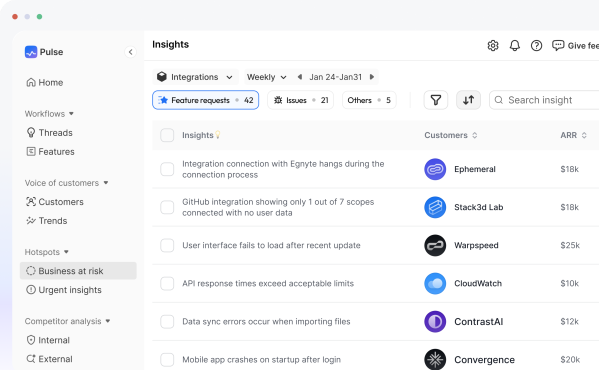
Pulse was built to solve this exact problem at enterprise scale. As an AI-native Feedback Intelligence platform, Pulse connects seamlessly to Zendesk, Freshdesk, Slack, Teams, Salesforce, HubSpot, Fireflies, Clari, JIRA, and dozens of other tools—unifying every customer signal into a single clean stream without forcing teams to change workflows.
Once data flows in, Pulse applies advanced machine learning to match, merge, and deduplicate feedback in real time. Its clustering models understand semantic similarity, contextual cues, product modules, and metadata patterns to ensure that every repeated issue is grouped into a single, accurate insight.
This means that if ten customers report the same problem across different channels, Pulse counts it once, traces it to every original source, and presents it with complete transparency. For PMs, this results in precise prioritisation without noise or inflation. For Customer Success, this creates a unified narrative and consistent response, dramatically improving customer satisfaction. Teams finally operate with one version of the truth.
Transformational Benefits for Product and CS Teams
- Product Managers no longer waste time cleaning data and instead focus on understanding real customer needs
- Roadmaps become sharper because decisions are grounded in accurate, deduplicated demand
- Customer Success teams deliver faster, more coherent responses with a single view of every issue
- Clean data strengthens cross-functional alignment—engineering trusts product's priorities, leadership trusts the metrics
- Companies with strong data quality foundations consistently outperform in customer retention and product velocity
Clean Data, Better Products, Happier Customers
Data duplication quietly undermines product clarity, customer experience, and business velocity. It's one of the most overlooked risks inside SaaS organisations—but also one of the easiest to fix with the right intelligence layer.
Pulse gives teams the ability to move from scattered, duplicated chaos to a single, trustworthy foundation for product decisions. Clean data leads to better prioritisation, faster shipping cycles, and stronger customer relationships. If you're building modern SaaS, this isn't optional anymore; it's a competitive advantage. Don't let duplication derail your product vision.
Learn how leading teams turn feedback into actionLearn How Leading Teams Turn Feedback Into Action

AI Turns Customer Research From an Event Into a SystemAI Turns Customer Research From an Event Into a System
Customer research used to be something a team scheduled — a round of interviews, a quarterly survey, a sprint before a launch. Structurally, that was always a snapshot. AI changes the cadence, not just the speed: research becomes a standing picture rather than a periodic report. But a continuously updated picture can look comprehensive without being representative.Customer research used to be something a team scheduled — a round of interviews, a quarterly survey, a sprint before a launch. Structurally, that was always a snapshot. AI changes the cadence, not just the speed: research becomes a standing picture rather than a periodic report. But a continuously updated picture can look comprehensive without being representative.
16 Sep 202616 Sep 2026

AI Isn’t Replacing Product Managers. It’s Repricing Their Time.AI Isn’t Replacing Product Managers. It’s Repricing Their Time.
A lot of a PM’s week was never spent deciding anything — it was spent preparing to decide. AI collapses that preparation time, but the bottleneck didn’t disappear; it relocated. Producing product work is getting cheap faster than making a good product decision is, and judgement is becoming the entire differentiator.A lot of a PM’s week was never spent deciding anything — it was spent preparing to decide. AI collapses that preparation time, but the bottleneck didn’t disappear; it relocated. Producing product work is getting cheap faster than making a good product decision is, and judgement is becoming the entire differentiator.
1 Sep 20261 Sep 2026
Security & Compliance You Can Trust




Security & Compliance You Can Trust
See how Pulse works with your data
Book a Demo