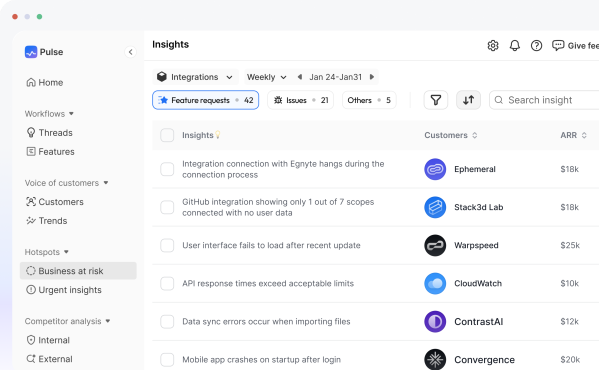
Can't I Just Build This With an LLM? Why Replicating Pulse Is Much Harder Than It Looks
Introduction
Every week, someone asks us a version of the same question:
"This looks interesting… but couldn't we just build something like this internally using an LLM?"
It's a fair question. On the surface, it feels plausible. Modern AI models can summarise text, detect sentiment, cluster feedback, and generate reports. So why not connect one to your data and build your own feedback intelligence system?
The short answer: because Pulse is not an LLM wrapper. The real answer is more interesting — and far more revealing about how enterprise AI actually works.
The Illusion: If an LLM Can Do It Once, You Can Productise It
The current AI wave has created a widespread misconception:
If an LLM can perform a task once, turning it into a reliable system is easy.
In reality, there's a massive difference between a demo and a production system.
An LLM can:
- Summarise a ticket
- Classify a transcript
- Cluster a dataset
But enterprises don't need isolated answers. They need continuous, reliable, explainable intelligence that runs across millions of signals and ties directly to business outcomes.
That gap — between one-off intelligence and operational intelligence — is where most internal builds fail.
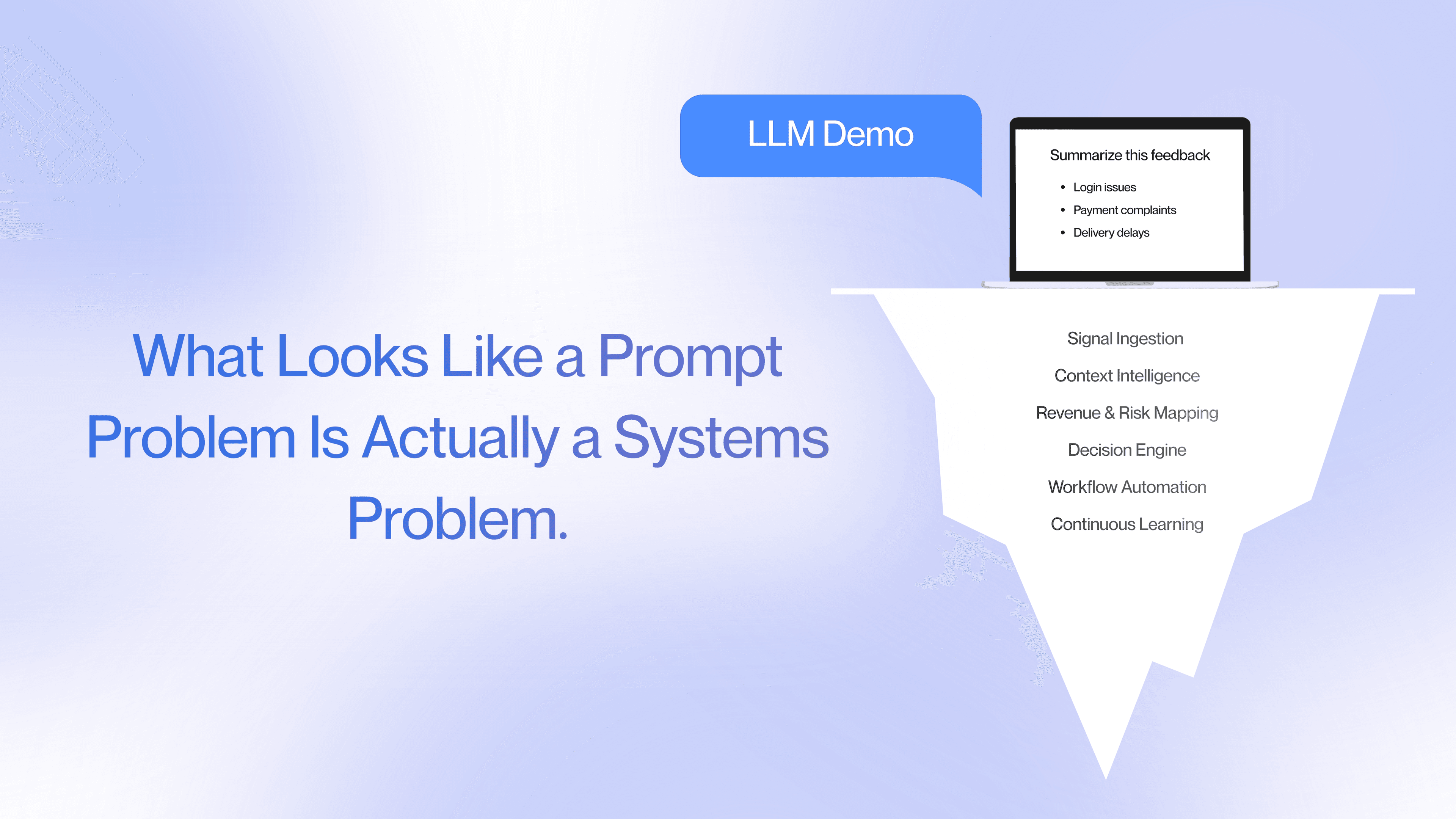
What Looks Like a Prompt Problem Is Actually a Systems Problem
Imagine you try building a solution internally.
You connect:
- Support tickets
- CRM notes
- Call transcripts
- Slack messages
You ask an LLM:
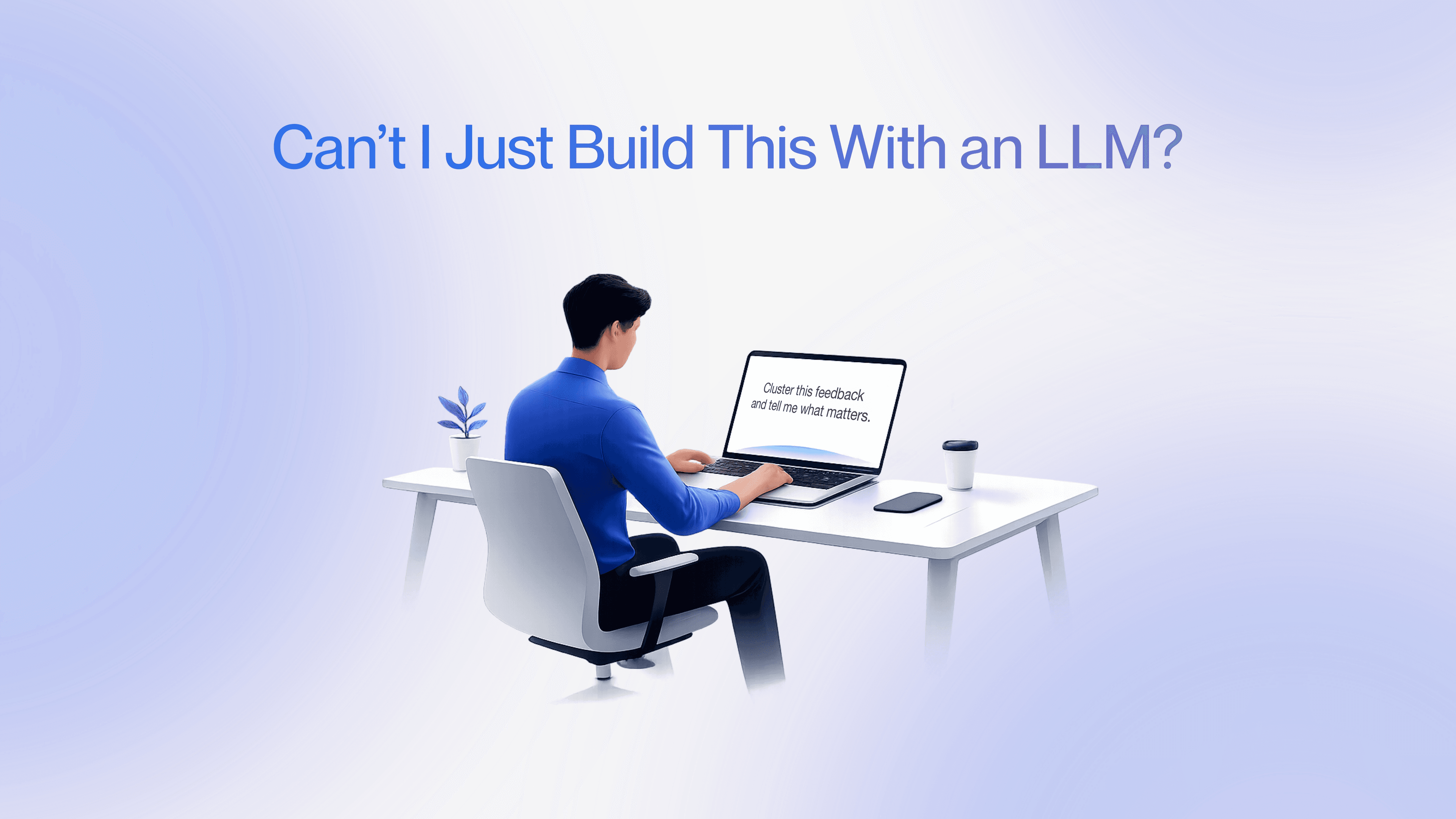
"Cluster this feedback and tell me what matters."
You'll get an output. Maybe even a good one.
But here's what happens next.
1. Real Enterprise Data Is Messy, Not Model-Ready
Production feedback data is:
- Duplicated
- Incomplete
- Mislabeled
- Contradictory
- Biased
- Multi-lingual
- Context-dependent
Cleaning this isn't a prompt engineering task. It's a data infrastructure + ML pipeline + orchestration problem.
Before Pulse produces any insight, multiple specialised agents run:
- Cleansing agents
- Deduplication agents
- Semantic clustering agents
- Entity resolution systems
- Segmentation models
- Signal weighting logic
Most of this work is invisible. But this layer is the foundation of real intelligence.
2. Raw Insights Without Context Are Misleading
An LLM might tell you:
"Users complain about login issues."
But a product or CS leader actually needs:
"Enterprise customers using SSO in APAC show elevated churn risk due to authentication failures impacting high-value accounts."
That requires:
- Business metadata mapping
- Revenue linkage
- Segmentation intelligence
- Account hierarchy awareness
- Temporal trend analysis
LLMs don't know your business context automatically. Pulse builds a self-learning contextual intelligence layer unique to every organisation.
That contextual layer is one of the hardest systems to build — and the hardest to replicate.
3. Summaries Don't Drive Decisions
Most internal AI builds stop at summaries or dashboards.
But teams don't need summaries. They need decisions.
Real workflows require:
- Prioritised backlogs
- Roadmap-ready items
- Stakeholder-aligned scoring
- Executive-ready narratives
- Execution triggers
This is where DIY solutions stall. Because now you're not building a tool. You're building a decision engine.
Pulse doesn't just analyse feedback. It operationalises it:
- Ranks work by impact
- Generates PRDs
- Prepares leadership briefs
- Syncs with execution tools
- Tracks outcomes
That's not a prompt. That's product architecture.
4. Reliability Is the Real Barrier
Anyone can get an LLM to produce output.
Very few can make it:
- Consistent
- Explainable
- Traceable
- Auditable
- Secure
- Fast
- Cost-efficient
Enterprises don't adopt AI because it's clever. They adopt it because it's dependable.
Pulse ensures every recommendation can be traced back to real signals. Every insight can be explained. Every decision can be justified.
That level of reliability requires engineering depth — not prompt tuning.
5. The Hidden Complexity: Continuous Learning Systems
A prototype answers questions. A platform learns.
Pulse continuously improves by observing:
- Which insights users accept or override
- Which recommendations lead to action
- Which signals correlate with revenue outcomes
- Which patterns repeat across customers
This creates a compounding intelligence advantage.
Static internal builds rarely reach this stage because maintaining learning systems requires dedicated infrastructure and modelling layers.
What Companies Realise After Trying to Build It
Teams that attempt internal versions usually discover something unexpected:
They didn't build a feature. They accidentally started building a product company.
What seemed like:
"Let's connect an LLM to feedback"
turns into:
- Pipeline orchestration
- Prompt versioning
- Evaluation frameworks
- Monitoring systems
- Drift detection
- Infrastructure scaling
- Cost optimisation
- Access controls
- Integrations
- Security reviews
At that point, the real question becomes:
"Should our engineers be solving this problem — or our core product problem?"
The Real Differentiator
"Pulse's advantage isn't that it uses AI. Everyone uses AI now. The difference is how intelligence is structured, contextualised, and operationalised into decisions tied to business outcomes. Not AI answers. AI decisions."

A Simple Way to Think About It
Building an LLM prototype is like assembling a racecar engine on a table.
Building Pulse is:
- Designing the car
- Tuning the engine
- Building the track
- Training the driver
- Installing telemetry
- And winning repeatedly
The engine alone isn't the system.
Final Thought
LLMs didn't eliminate the need for platforms. They made platforms more important.
Because as raw intelligence becomes easy to generate, structured intelligence becomes the real competitive advantage.
That's what Pulse is built for.
Pulse, where feedback becomes decisions — and decisions become growth.
Learn how leading teams turn feedback into actionLearn How Leading Teams Turn Feedback Into Action

AI Turns Customer Research From an Event Into a SystemAI Turns Customer Research From an Event Into a System
Customer research used to be something a team scheduled — a round of interviews, a quarterly survey, a sprint before a launch. Structurally, that was always a snapshot. AI changes the cadence, not just the speed: research becomes a standing picture rather than a periodic report. But a continuously updated picture can look comprehensive without being representative.Customer research used to be something a team scheduled — a round of interviews, a quarterly survey, a sprint before a launch. Structurally, that was always a snapshot. AI changes the cadence, not just the speed: research becomes a standing picture rather than a periodic report. But a continuously updated picture can look comprehensive without being representative.
16 Sep 202616 Sep 2026

AI Isn’t Replacing Product Managers. It’s Repricing Their Time.AI Isn’t Replacing Product Managers. It’s Repricing Their Time.
A lot of a PM’s week was never spent deciding anything — it was spent preparing to decide. AI collapses that preparation time, but the bottleneck didn’t disappear; it relocated. Producing product work is getting cheap faster than making a good product decision is, and judgement is becoming the entire differentiator.A lot of a PM’s week was never spent deciding anything — it was spent preparing to decide. AI collapses that preparation time, but the bottleneck didn’t disappear; it relocated. Producing product work is getting cheap faster than making a good product decision is, and judgement is becoming the entire differentiator.
1 Sep 20261 Sep 2026
Security & Compliance You Can Trust




Security & Compliance You Can Trust
See how Pulse works with your data
Book a Demo