The Product Manager Role Is Quietly Changing

Introduction
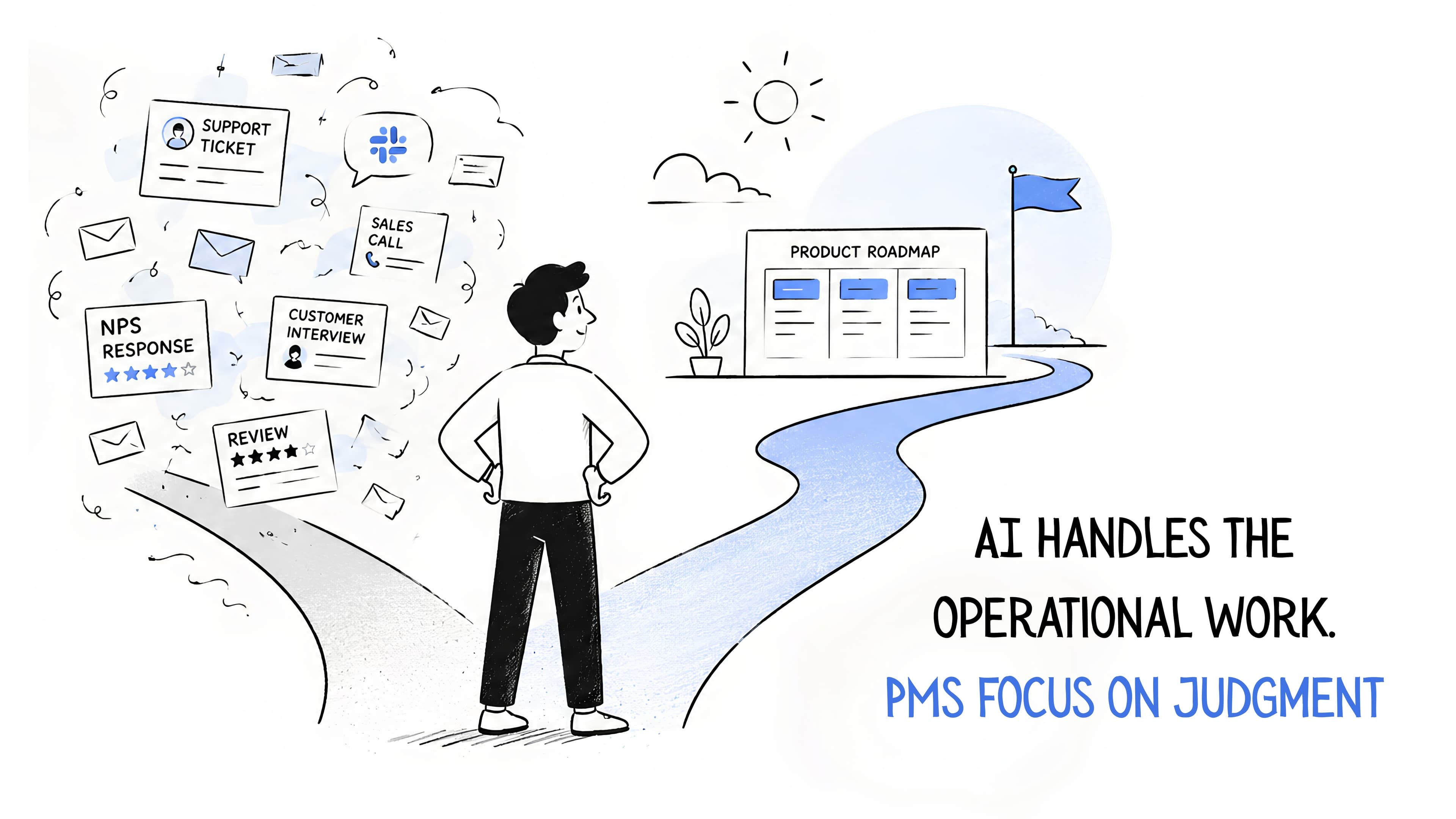
One of the biggest misconceptions around AI in product management is that: AI will replace PMs.
That’s probably the wrong framing.
What AI is far more likely to replace is: ● repetitive synthesis ● manual clustering ● signal aggregation ● context collection ● operational overhead
And that changes the PM role significantly.
Product Teams Are Drowning in Signals
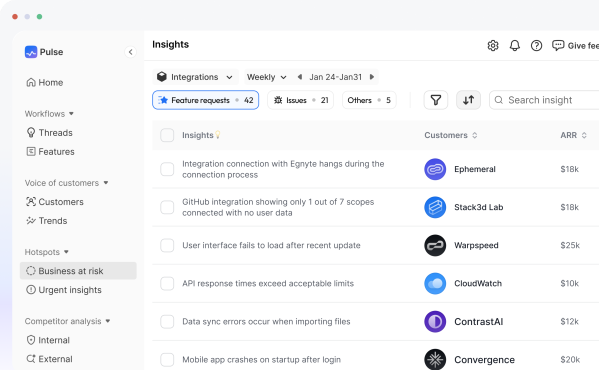
Modern product organisations receive feedback from everywhere:
- support tickets
- sales calls
- Slack channels
- customer interviews
- reviews
- NPS responses
- onboarding friction
- churn conversations
The challenge isn’t access to customer insight anymore. The challenge is operational bandwidth.
Most PMs spend enormous time:
- gathering context
- reconciling conflicting inputs
- validating urgency
- identifying patterns manually
That work doesn’t scale particularly well. Especially as customer operations become increasingly digital.
AI Changes the Shape of Product Work
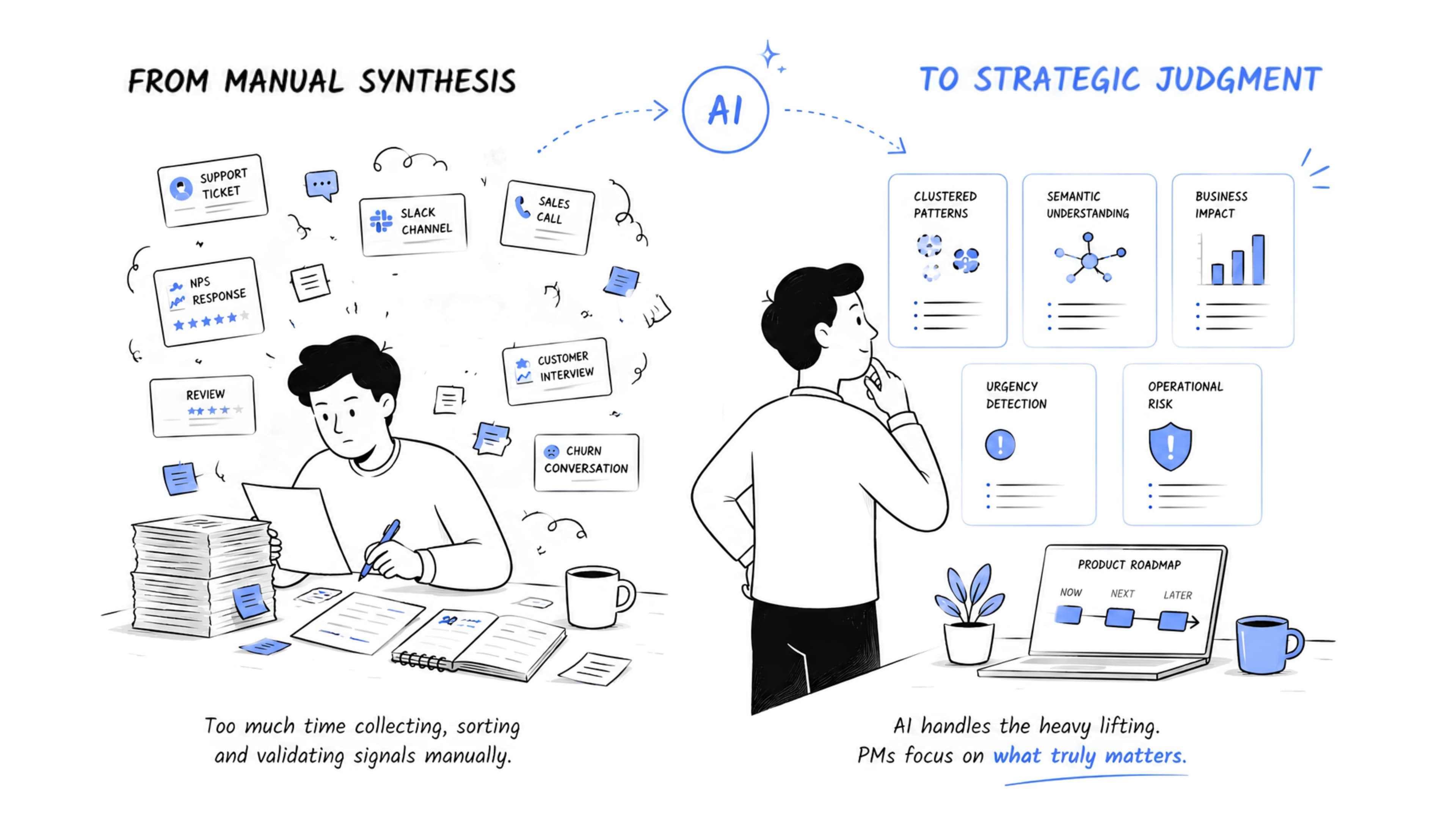
As AI systems become better at:
- clustering patterns
- understanding semantic similarity
- mapping business impact
- identifying urgency
- surfacing operational risk
the role of the PM naturally evolves.
The PM increasingly stops acting as: a human aggregation engine and starts acting as: a strategic orchestration layer
That’s a meaningful shift.
Because the leverage moves from: ● collecting information to: ● exercising judgement
Decision Velocity Becomes Competitive Advantage
In fast-moving product organisations, one of the biggest bottlenecks isn’t engineering. It’s decision latency.
How long does it take the organisation to:
- recognise emerging problems
- align cross-functional context
- prioritise action
- execute confidently
AI systems won’t eliminate product judgement. But they will increasingly compress the time required to reach clarity.
And organisations that reduce decision latency significantly will operate very differently from those still manually processing signals.
Product Management Doesn’t Disappear — It Evolves
Great PMs were never valuable because they could read more tickets. They were valuable because they could:
- reason through ambiguity
- prioritise tradeoffs
- align organisations
- make difficult decisions
AI simply shifts more operational overhead away from humans and toward systems.
That allows PMs to operate closer to their highest-leverage function. Judgement.
Final Thought
The future PM likely spends:
- less time synthesising signals
- less time searching for context
- less time manually validating patterns
And significantly more time:
- making strategic decisions
- coordinating execution
- shaping product direction
That’s not the removal of product management. It’s the evolution of it.
Learn how leading teams turn feedback into actionLearn How Leading Teams Turn Feedback Into Action

AI Turns Customer Research From an Event Into a SystemAI Turns Customer Research From an Event Into a System
Customer research used to be something a team scheduled — a round of interviews, a quarterly survey, a sprint before a launch. Structurally, that was always a snapshot. AI changes the cadence, not just the speed: research becomes a standing picture rather than a periodic report. But a continuously updated picture can look comprehensive without being representative.Customer research used to be something a team scheduled — a round of interviews, a quarterly survey, a sprint before a launch. Structurally, that was always a snapshot. AI changes the cadence, not just the speed: research becomes a standing picture rather than a periodic report. But a continuously updated picture can look comprehensive without being representative.
16 Sep 202616 Sep 2026

AI Isn’t Replacing Product Managers. It’s Repricing Their Time.AI Isn’t Replacing Product Managers. It’s Repricing Their Time.
A lot of a PM’s week was never spent deciding anything — it was spent preparing to decide. AI collapses that preparation time, but the bottleneck didn’t disappear; it relocated. Producing product work is getting cheap faster than making a good product decision is, and judgement is becoming the entire differentiator.A lot of a PM’s week was never spent deciding anything — it was spent preparing to decide. AI collapses that preparation time, but the bottleneck didn’t disappear; it relocated. Producing product work is getting cheap faster than making a good product decision is, and judgement is becoming the entire differentiator.
1 Sep 20261 Sep 2026
Security & Compliance You Can Trust




Security & Compliance You Can Trust
See how Pulse works with your data
Book a Demo